
Higher Ground
By Phillip Shabazz
The riot had no name— the sky cracked its throat on siren-song. Asphalt learned to swallow whole. A sneaker—pink, child-sized—spins mid-air mid-cry mid-century. The streets don't burn. They are burning. They have always burned in the tense I don't teach. Glass doesn't shatter. It speaks in the language of aftermath, in the grammar of never-arrived-home. Listen: a stop sign is a grave marker if I know how to read it.
Aaron. Not theory. Chipped tooth. Tic Tacs rattling in his pocket like dice like a rosary like evidence. They said gun. They said description. They said the footage—but footage is just another word for what we choose to frame, what we crop from the shot. His hoodie too bright. His skin the wrong aperture for mercy. The corner store still hums his laugh back, that frequency the news can't tune to, won't hold, drops like a call from a country with no extradition treaty for the dead. I saw the stain before the story.
This riot: older than my name, engraved in marrow, encoded in the lullaby of rotors overhead. Grandfather— Black Moses with a butter knife for staff— never spoke of '68, just said "We don't run from fire" and meant "We are the fire, we've been burning since the boats, since the sale, since the sight of our own bodies became the first literacy we were denied." He split yams, not seas. Said grace with his silence. My father drank the grief he couldn't name. I? I carry it—a lit match in my throat, a pilot light that won't go out won't let me sleep won't let me be anything other than awake.
Awake: my mother wipes tear gas from my eyes, smells like jasmine and frying potatoes while the city burns three blocks over. She says Look and means "Don't you dare close my eyes." Kerry's Sunday Morning plays somewhere, a hymn for the always-mended, for the ritual of the next day. The riot is Budget meetings. Redlining ink. The silence after the judge reads the verdict.
My camera's up. My chant is rising. I link arms. I won't be moved. We are the sound they keep hitting snooze on, that they call tragic instead of predictable. A man cries across the street. Not shouting, crying. I don't know him, but I know that frequency, have hummed it myself in the shower, in the car, in the two a.m. of why-are-we-still-here.
Later—and there's always a later, another after, another morning where the news moves on but the stain stays— I lean against a storefront worn as my grandmother's praying hands, trace the bruise across my ribs: baton-kiss, or prophecy. Seen only when the seeing serves the seer. I am the lung that refuses to collapse. The collective heartbeat insists on we. Not one voice. A chorus. Smoke-thick, blood-warm, ancestral. Every name unspoken speaking now through this mouth, this body that walks toward something not yet built—
Higher ground is the witness stand. Let the record show. Prophets wear hoodies and Timbs and carry poems in their pockets next to the gummy worms, next to the ID that won't save them, next to the phone set to record because I've learned: footage is the only prophet they believe and even then, only sometimes, only maybe, only if the light is right. Our bodies, burning storefront signs insisting on their own dark visibility.
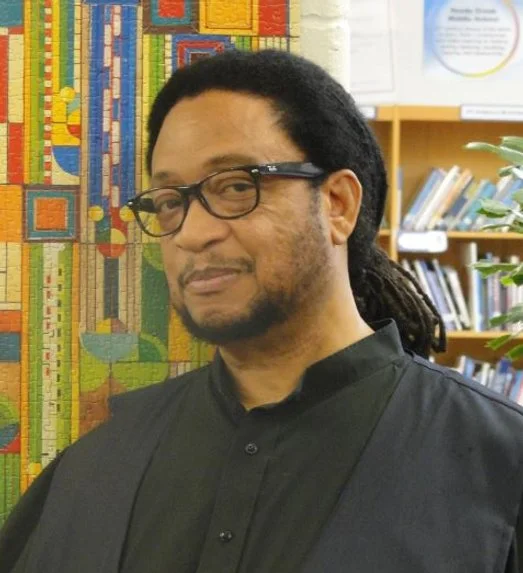
Phillip Shabazz is the author of four poetry collections, and a novel in verse. His most recent collection, Moonflower, is published by Fernwood Press.
His work has been nominated for Best Of The Net and has been included in the anthologies, Paul Green: North Carolina Writers on the Legacy of the State's Most Celebrated Playwright, Crossing the Rift: North Carolina Poets on 9/11 & Its Aftermath and Home Is Where: African American Poetry from the Carolinas. Some publication credits in journals include, Fine Lines, Florida Review, Galway Review, Mason Street, Queens Quarterly, K'in, and Thimble.