
Elegy for My Mother
By Phillip Shabazz
The night she served us cereal for dinner because the gas was cut off,
she lit candles like it was a birthday party. Said grace over Cheerios.
We believed her when she called it a feast. Seven of us around
that table, bowls chipped at the rim, milk stretched thin with water,
and she sat there smiling like she'd pulled off a miracle. Maybe she had.
At the grocery store, the cashier counted her food stamps twice,
loud enough for the line to hear. My mother kept her eyes forward,
kept counting back her change, penny by penny, then turned to me
and said, Baby, hold your head up. We paid for this food same as anybody.
The cashier's hand was still on the register.
My mother's hand was on my shoulder.
I found her in the backyard at 5 a.m., wringing sheets in ice water,
her knuckles split and bleeding because the washer broke
and she had seven of us to get clean for school. When I asked
if she was okay, she said, The cold just makes them red, baby.
Go get dressed. She hung the last sheet. The sun hadn't come up yet.
By the time we woke, there was breakfast on the table
and her hands wrapped in dish towels like they'd never bled at all.
Ninety-five years. Cotton house shoes worn through at the heel.
Her hands—I keep seeing her hands. Not metaphor. Not symbol.
Her actual hands: the right thumb bent wrong from the factory
machine in '64, the scar across her left palm from the knife
that slipped cutting okra, the places where the skin had gone
thin as Bible pages, the wedding ring she never took off
even after he was gone, even after the arthritis made it hurt to wear.
Sunday mornings, those hands moved through our hair—
parting, greasing, braiding—while Mahalia Jackson sang
from the kitchen radio. Her hands knew the pattern: section, grease,
plait, pin. Seven heads. Two hours. One woman who never said
she was tired, who sang along to "Precious Lord" while
her fingers worked, who made beauty out of us even when
we didn't know we were something that needed making.
She used to stand in the screen door at dusk.
We thought she was resting. Now I understand she was counting—
one, two, three, four, five, six, seven— making sure all of us
were still visible, still breathing, still hers. The world is a catalog
of ways to lose your children and she was the only one who
knew all our names.
I imagine her folding laundry in the hospital bed.
Even then. Even dying. Her hands needed work. She smoothed
a pillowcase, creased it down the middle, said,
Make sure you iron this before company comes.
There was no company coming. There was no going home.
But her hands remembered what they were made for. Kept folding.
Kept making order. Kept being hands that knew how
to hold everything together even as everything was coming apart.
When she died, I dreamed they asked if I wanted her wedding ring.
I said no. Let her keep it. Let her hands, for once,
hold only what they chose, not what they had to carry.
The house didn't empty when she left. It filled. With her.
The kitchen light she left burning. The smell of Clorox
and Pine-Sol in the corners. The screen door that never closed right.
The place at the table, the wood worn smooth not from elbows
but from fifty years of her leaning in, listening to seven versions
of the same day, feeding us, feeding us,
always feeding us even when there was nothing left to give.
I don't believe in heaven the way she did.
But I believe in this: her hands, finally resting. The food stamps turning
to dust in some county office. The cereal by candlelight remembered
not as shame but as the night she said grace over what we had
and made us believe it was everything.
The house didn't empty when she left. Her hands are still here—
in the ice water. In the Cheerios. In the change counted back.
In the sheets hung before dawn. In the door she stood watch at.
In the ring she kept wearing. In the pillowcase she kept folding. I
n the shoulder where her hand rested and said: Hold your head up.
Mom. Mama. Mother. The hands in the ice water at 5 a.m.
The hands that counted change, penny by penny.
The hands we'll never forget.
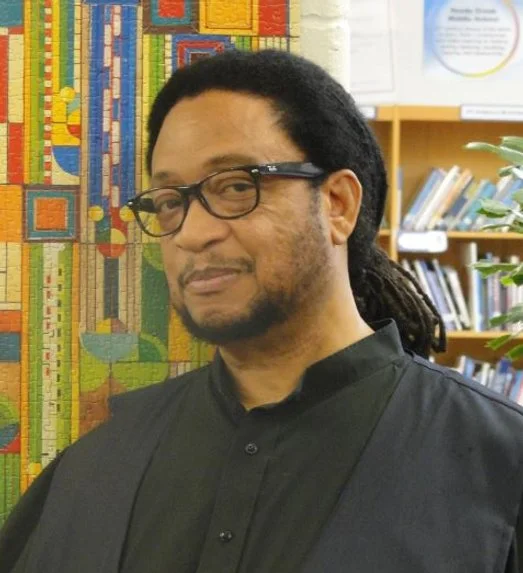
Phillip Shabazz is the author of four poetry collections, and a novel in verse. His most recent collection, Moonflower, is published by Fernwood Press.
His work has been nominated for Best Of The Net and has been included in the anthologies, Paul Green: North Carolina Writers on the Legacy of the State's Most Celebrated Playwright, Crossing the Rift: North Carolina Poets on 9/11 & Its Aftermath and Home Is Where: African American Poetry from the Carolinas. Some publication credits in journals include, Fine Lines, Florida Review, Galway Review, Mason Street, Queens Quarterly, K'in, and Thimble.