
Slim Jim
By Phillip Shabazz
He stood five-foot-ten, built like a man
who never slept through a door slam.
His father's shoulders. His grandmother's mouth.
A scar above his left eye that changed its story
depending on who asked.
He walked before morning, when the city
still had its eyes shut, past the streetlight
dead since September, past porches bowed
like old men praying to nothing, past the rent notice
under Miss Clara's door, folded neat as a blade.
The clinic was locked. Inside, the chairs sat in rows
like people waiting to be told no.
His mother had sat there once, breathing
through a paper mask. Her name was misspelled
on the form, her lungs filled with the dust
his father carried home from the factory.
Slim Jim stood at the glass and saw himself
doubled there: one man outside, one man already gone.
Then the ice took him. Quick. His feet flew up
and his father's bones hit the concrete first.
He lay a minute with the air knocked out of him,
looking up at a sky gone flat and white
as an unpaid bill. A curtain moved.
Nobody came. That was the old lesson. He got up.
At the back of the store, his fingers found the lock,
his grandmother's fingers counted quarters at midnight,
his mother's fingers signed forms with words above her name
she could not enter, his own fingers at seven
reached past sleep, shame, the porch light, toward bread.
The lock gave. He took rice, milk, batteries, socks, aspirin,
a coat with the tags still on, three envelopes
of cash from under the drawer. He did not hurry.
By morning the block found him everywhere.
A twenty under Miss Clara's mat. Rice
on the steps where the twins lived. Milk
by the door of the man who coughed blood
and called it a cold. Socks in a mailbox.
A coat folded clean over the railing
where his mother used to lean when breathing was work.
Nobody said his name. But every lock
on the block remembered his hands.
At noon the police came with their questions.
Curtains held still. Mouths stayed closed.
Even the dog that barked at everything
put its head down and watched the street.
Slim Jim was already gone, walking
into the city's white breath, his bad shoes
bitter with slush, and somewhere behind him
the block sat down to eat, not knowing
or asking whose hands had fed them,
only that tomorrow the locks would still be there,
and so would he.
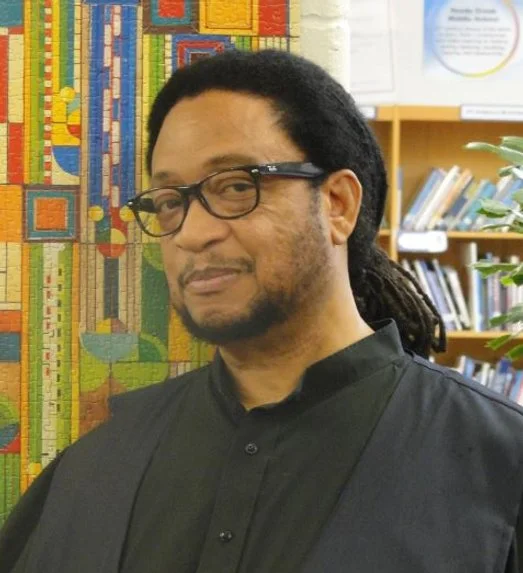
Phillip Shabazz is the author of four poetry collections, and a novel in verse. His most recent collection, Moonflower, is published by Fernwood Press.
His work has been nominated for Best Of The Net and has been included in the anthologies, Paul Green: North Carolina Writers on the Legacy of the State's Most Celebrated Playwright, Crossing the Rift: North Carolina Poets on 9/11 & Its Aftermath and Home Is Where: African American Poetry from the Carolinas. Some publication credits in journals include, Fine Lines, Florida Review, Galway Review, Mason Street, Queens Quarterly, K'in, and Thimble.